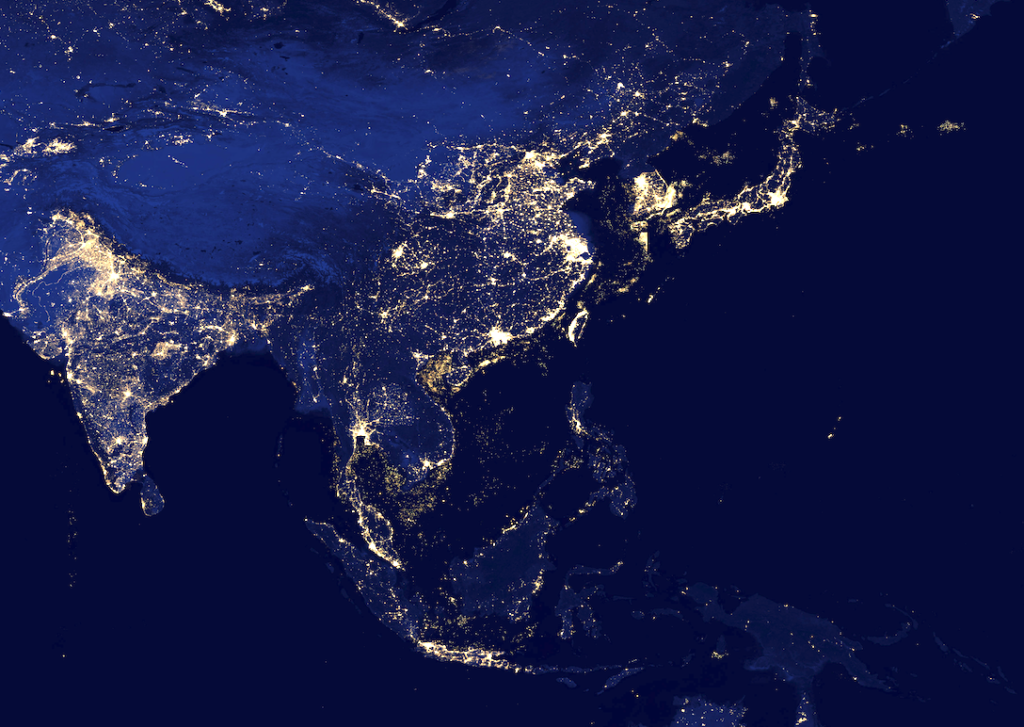

The geopolitical discourse surrounding the Indo-Pacific is frequently framed through the narrow prism of great-power competition between the United States and the People’s Republic of China. While the rivalry between Washington and Beijing undeniably remains a defining axis of regional dynamics, this bilateral focus obscures a more fundamental structural transformation underway across the region. Rather than coalescing into a rigid, bipolar confrontation reminiscent of the Cold War, the Indo-Pacific is evolving into a complex, networked order wherein a diverse cohort of middle powers actively configures regional norms, economic frameworks, and security arrangements. Nations such as India, Japan, Australia, South Korea, Indonesia, Singapore, and Vietnam have emerged not merely as passive recipients of great-power policies, but as indispensable architects of regional stability and governance.
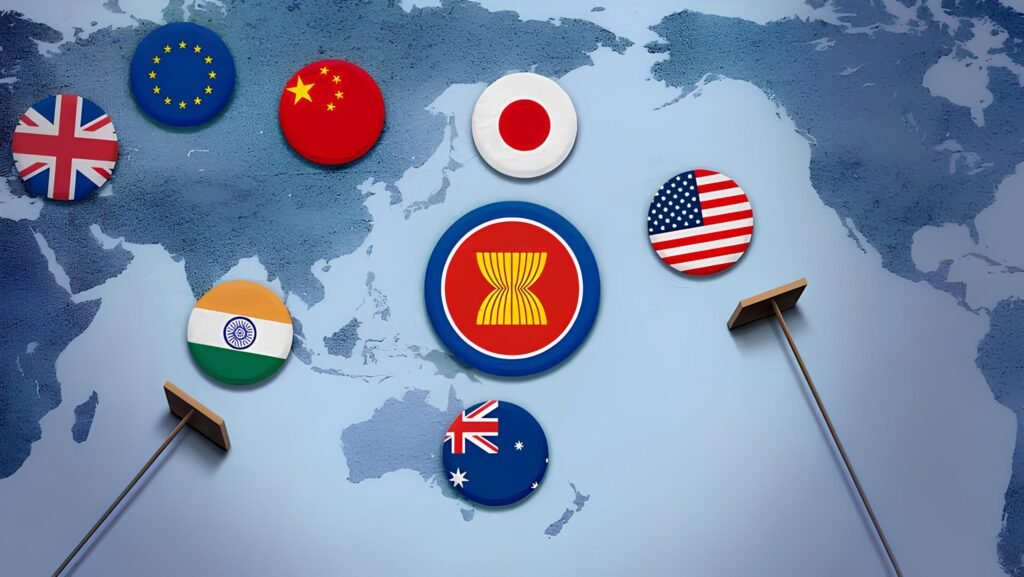
The Core Strategy: Diversification and Strategic Optionality
At the heart of middle-power behavior in the contemporary Indo-Pacific is the pursuit of strategic autonomy. Confronted with the risks of total alignment with either Washington or Beijing, middle powers have systematically chosen to maximize their strategic optionality rather than submit to binary choices. This approach does not signify passive neutrality; rather, it represents a proactive, calculated strategy designed to preserve national sovereignty, reduce systemic vulnerabilities, and widen policy alternatives in an increasingly volatile security environment.
India serves as a prominent archetype of this strategic diversification. While New Delhi has progressively enhanced its defense interoperability and intelligence-sharing mechanisms with the United States through participation in the Quadrilateral Security Dialogue (Quad), it concurrently maintains robust diplomatic engagement within BRICS, the Shanghai Cooperation Organisation (SCO), and broader leadership forums across the Global South. By participating simultaneously in Western-aligned maritime security initiatives and non-Western multilateral bodies, India ensures that its diplomatic leverage is never subordinated to the strategic prerogatives of an external power.
Norm Setting and Institutional Architecture: The Japanese and Australian Models
Middle-power influence in the Indo-Pacific is equally defined by the capacity to establish international standards, foster economic resilience, and pioneer flexible diplomatic mechanisms. Japan exemplifies how structural power can be wielded through diplomatic vision and institutional rule-making rather than unilateral military force alone. Despite constitutional constraints and domestic demographic pressures, Tokyo conceived and advanced the concept of a “Free and Open Indo-Pacific,” successfully elevating principles such as freedom of navigation, international legal norms, and high-standard infrastructure financing into the regional lexicon. Japan’s proactive role in securing regional supply chains and establishing technological standards demonstrates that norm-setting capabilities are as consequential to regional order as material power projection.
Similarly, Australia has pioneered agile diplomatic and defense arrangements to reconcile its historical security partnership with the United States and its deep economic ties across Asian markets. Canberra has increasingly favored minilateral frameworks—such as AUKUS and the Quad—which facilitate focused cooperation on targeted issues including maritime domain awareness, advanced defense technologies, critical minerals supply, and cybersecurity. Unlike expansive, consensus-bound multilateral institutions, these flexible minilateral networks permit participating states to execute practical, high-level cooperation on vital challenges without requiring rigid, overarching political alignment, effectively shifting regional governance toward dynamic coalitions of shared interest.
Southeast Asian Agency and the Expansion of Geoeconomic Influence
Nowhere is the agency of middle powers more evident than in Southeast Asia, where members of the Association of Southeast Asian Nations (ASEAN) have decisively rejected the notion of being passive arenas of great-power rivalry. Indonesia has continuously leveraged its diplomatic stature to reinforce ASEAN centrality and guide regional dialogue, ensuring that regional security mechanisms remain anchored in consensus and non-alignment. Meanwhile, Singapore has entrenched itself as an indispensable nexus for global finance, technology arbitration, and high-end logistics, while Vietnam has positioned itself as an essential manufacturing hub at the center of global supply-chain realignments.
This growing prominence underscores a structural shift in the nature of power itself. In the modern international system, influence is increasingly derived from a state’s specialized integration within critical economic, technological, and logistics networks. South Korea’s commanding role in advanced semiconductor manufacturing, Japan’s leadership in precision engineering, and Singapore’s maritime and digital connectivity demonstrate that technological and economic centrality confers profound geopolitical leverage. Consequently, middle powers possessing pivotal resources, manufacturing capacity, or strategic geography are capable of shaping the terms under which great-power competition occurs.
Toward a Polycentric Indo-Pacific
The emerging Indo-Pacific architecture cannot be accurately characterized as an impending bipolar showdown or a straightforward transition between hegemonic powers. Great-power competition will continue to exert significant structural pressure on regional affairs, but the ultimate trajectory of the Indo-Pacific will be determined by the dense web of minilateral agreements, economic corridors, and institutional partnerships constructed by middle powers. By pursuing strategic autonomy, establishing flexible coalitions, and leveraging critical network nodes, middle powers are actively diffusing power and constructing a more resilient, polycentric regional order.