

A New Front in Global Capitalist Crisis
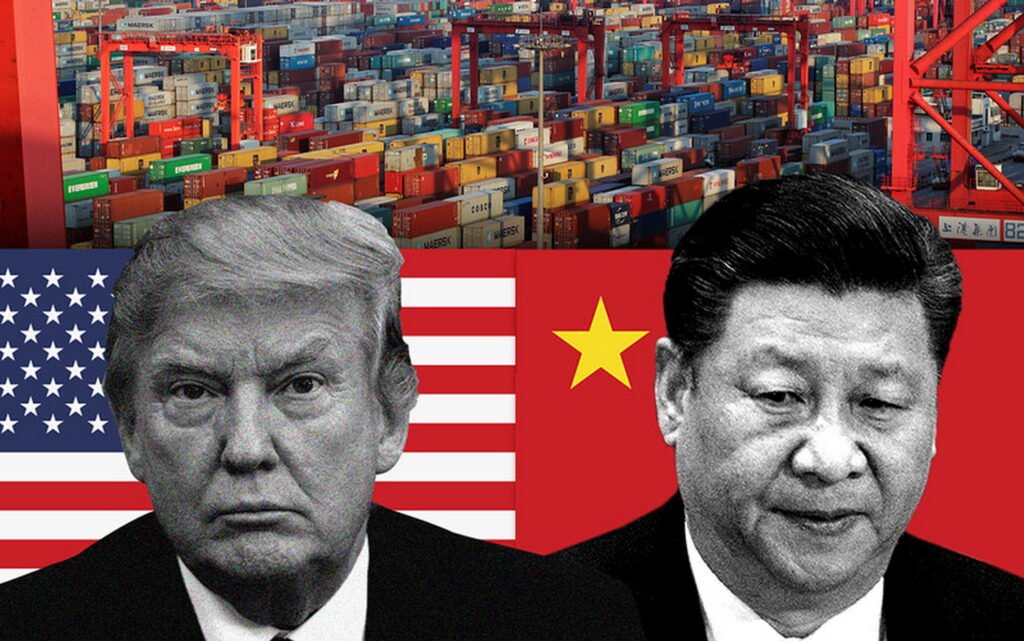
What began as a broad campaign of tariffs under President Donald Trump has crystalised into a full-blown trade conflict between the two most powerful economies in the world: the United States and China. At stake is not only global trade but the political and economic balance of power in the 21st century. The question that looms large is not merely who will blink first, but who truly holds the strategic advantage in this protracted contest.
Trump, true to his style, approached the trade war with characteristic bombast. Tariffs were deployed as blunt instruments, not simply to curb imports or protect domestic industries, but as a coercive tactic to force China into a “better deal.” However, this confrontational approach underestimated China’s capacity to absorb economic pain—and overestimated America’s own resilience.
Statements such as JD Vance’s televised remark—“We borrow money from Chinese peasants to buy the things those Chinese peasants manufacture”—reflect not only ideological condescension, but strategic myopia. While intended for domestic audiences, such rhetoric was swiftly amplified by Chinese media and received with visceral nationalistic anger. In a nation acutely conscious of its historical subjugation by Western powers, the insult ignited public sentiment and, ironically, strengthened China’s domestic support for a hardline response.
By launching this economic offensive, Washington handed Beijing the political tools to frame any domestic economic consequences as the product of American aggression. Instead of fracturing Chinese resolve, such provocations raised Beijing’s tolerance for economic disruption.
A Symbiotic Rivalry
While both sides can inflict harm, neither is immune to consequences. China may suffer from diminished access to its largest export market, but the United States is heavily dependent on Chinese imports—not only for consumer goods but for critical industrial components and rare-earth materials. The much-touted goal of rebuilding American manufacturing is an ambition fraught with complexity. Global supply chains, meticulously developed over decades, cannot be repatriated overnight.
In sectors such as electronics and green energy, China’s manufacturing supremacy is unrivalled. According to Goldman Sachs, for over a third of products that the US imports from China, Beijing supplies more than 70 percent of US demand. By contrast, just 10 percent of China’s imports from the US rely on American sources.
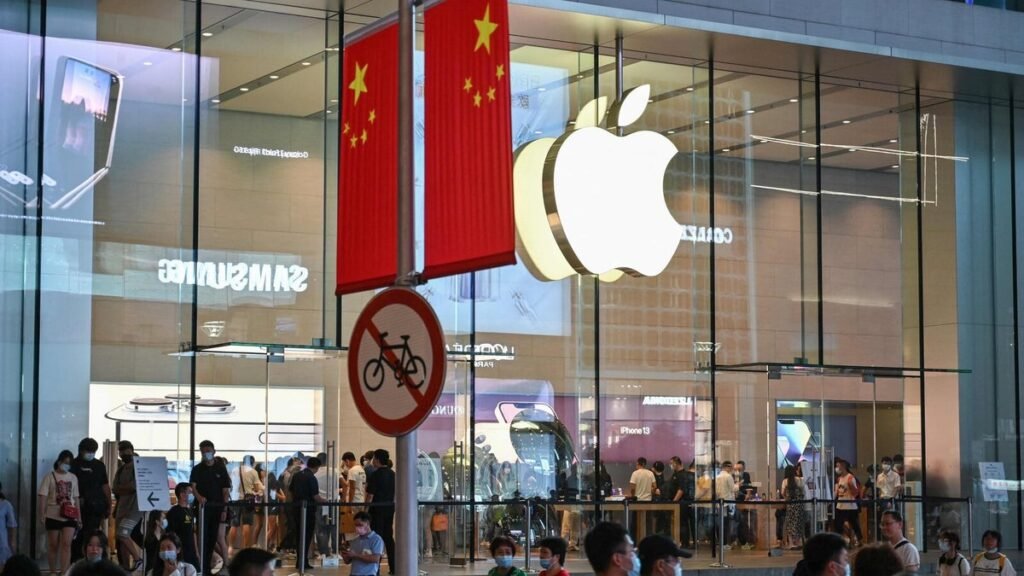
In strategic terms, China’s grip on global manufacturing and infrastructure provides it with greater economic leverage than the trade balance alone might suggest. Attempts to fully decouple these economies would inflict severe shocks. iPhones, for instance, could more than double in price if production were shifted stateside. And more broadly, tariffs imposed on Chinese goods are feeding inflationary pressures across the US economy, threatening a loss of consumer purchasing power and corporate profits.
The Trump administration framed tariffs as a short-term sacrifice for long-term gain—a resurgence in American industrial employment. Yet many US factories rely on Chinese parts. Tariffs make these inputs more expensive, further eroding competitiveness and potentially accelerating job losses. In attempting to correct the trade imbalance, Washington may inadvertently deepen the very crisis it seeks to reverse.
The Limits of Reindustrialisation
The idea of an American manufacturing renaissance, though politically popular, is economically elusive. High wages, regulatory costs, and a lack of technical infrastructure present significant barriers. It is estimated that relocating even 10 percent of Apple’s production back to the United States would cost upwards of $30 billion and take at least three years—during which time competitors would likely outpace American firms on the global stage.
At the same time, China faces a chronic overproduction crisis. In industry after industry, from steel to solar panels, Chinese capacity far exceeds global demand. Even allies such as Russia have imposed tariffs to protect themselves from a flood of cheap Chinese exports. The US tariffs exacerbate this pressure, depriving China of its primary market at a moment when economic expansion is already slowing, and its debt-laden real estate sector teeters on the brink.
Nonetheless, China’s long-term strategy has been to diversify its markets and invest in domestic innovation, thereby reducing its dependency on the United States. While painful, the trade war may accelerate this transition and foster greater economic independence—a development contrary to US objectives.
Financial Fragility and the Dollar Dilemma
Compounding these economic tensions is the mounting US national debt, now exceeding $36 trillion or 124 percent of GDP. The ability of the United States to sustain such deficits has historically rested on the unique role of the US dollar as the global reserve currency. This position has allowed Washington to borrow cheaply and extensively, as global investors treat US Treasury bonds as a safe haven. However, Trump’s aggressive use of tariffs—and his threats of sanctions against BRICS nations seeking alternatives to the dollar—have begun to erode this perception of stability. If confidence in the dollar falters, the US could face higher borrowing costs, reduced capital inflows, and ultimately a severe fiscal crisis. As recent capital flight and rising interest rates suggest, the ground beneath the dollar’s dominance is beginning to shift. The irony is stark: by leveraging the dollar’s centrality for geopolitical gain, the US may be hastening its own financial decline.
China and Russia are actively developing alternative settlement systems. European and Asian investors are questioning the reliability of US markets. Should foreign creditors withdraw en masse or cease to reinvest, Washington would be forced to implement harsh austerity or risk default—both politically toxic and economically disastrous.
An Unwinnable War?
This is not a conflict one side can “win.” The US and China are entwined in a mutually destructive confrontation, each leveraging economic pressure at the risk of triggering global instability. While Trump hopes tariffs will reindustrialise America and assert dominance, the likely outcome is stagflation, geopolitical fragmentation, and deeper domestic political unrest.
China, too, faces risks. Its export model is nearing exhaustion, and further isolation could destabilise its internal economy.
Yet, politically, Xi Jinping cannot afford to capitulate. His legitimacy rests on projecting strength against imperialist powers and positioning China as an equal force to the United States. To yield under pressure would betray that image.
The situation echoes a deeper reality: we are witnessing not a strategy gone awry, but the decline of global capitalism’s two main pillars. The interdependence that once fueled growth now renders crisis systemic. No national solution exists for the contradictions of overproduction, financial speculation, and imperial rivalry. What remains is a world order fraying at the seams.
From Trade War to Class War
The collapse of confidence in global trade and finance will not be resolved through tariffs or treaties. It will be expressed through rising inequality, class conflict, and political upheaval. While Trump postures as a champion of the working class, his policies may deepen the suffering of those he claims to defend.
If the promised “American Renaissance” fails to materialise, anger will not dissipate. Rather, it will search for a new direction—one that transcends both Trumpian nationalism and liberal globalism. The working class, in the United States and internationally, will be compelled to seek alternatives beyond capitalism.
This trade war is not an anomaly—it is the inevitable product of a decaying system. The old engines of global growth—US finance and Chinese manufacturing—are now in direct contradiction. Their struggle will shape the coming era, but neither side offers a real way forward.
Only the organised international working class, armed with a programme of socialist transformation, can put an end to this spiral of decline. The demand must be clear: not “America First,” nor “China First”—but Workers First, everywhere.