

Over the course of a single week in Los Angeles, Donald Trump’s administration ignited a national firestorm. What began as a wave of Immigration and Customs Enforcement (ICE) raids across immigrant-heavy neighborhoods quickly escalated into a political confrontation involving the National Guard, military threats, mass protests, and scenes of police brutality. This was not an organic eruption of violence or a law enforcement necessity — it was a manufactured crisis designed for political spectacle and authoritarian posturing.
Through a coordinated series of workplace raids, Trump’s ICE agents, supported by the Los Angeles Police Department (LAPD), descended on the city with military-style force. One such raid targeted the Ambiance Apparel factory in downtown Los Angeles, where federal officers arrested dozens of immigrant workers, including the father of a 24-year-old woman named Luisa. “It was a manhunt,” she said, describing the chaos that unfolded as armored vehicles surrounded the factory. Luisa’s experience became emblematic of the broader crisis — a story of state terror, family separation, and political exploitation.
Escalation and Resistance
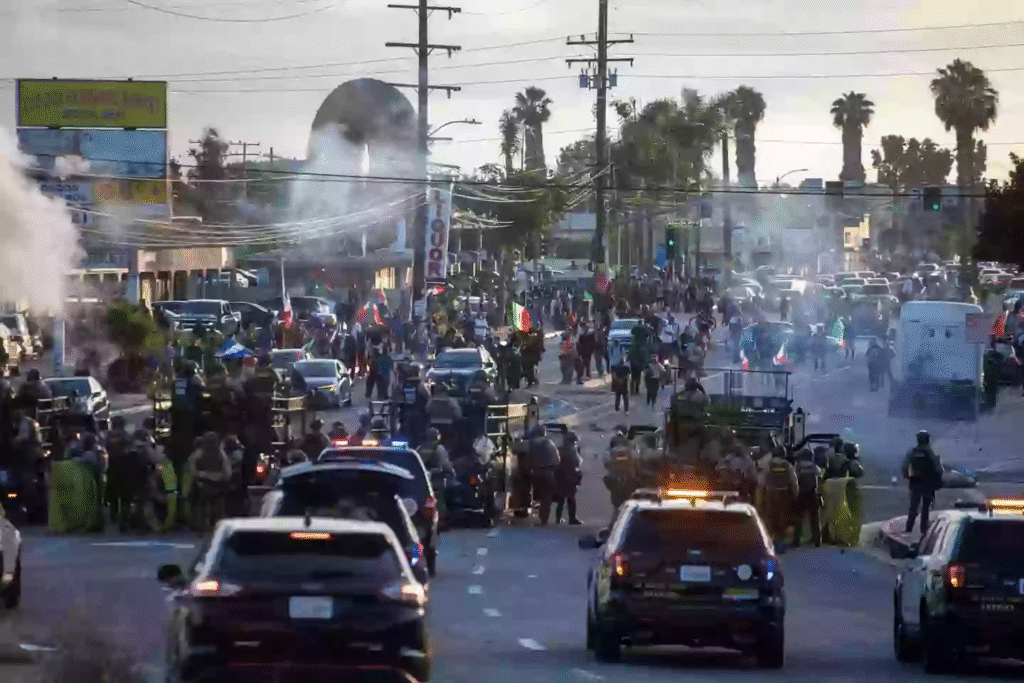
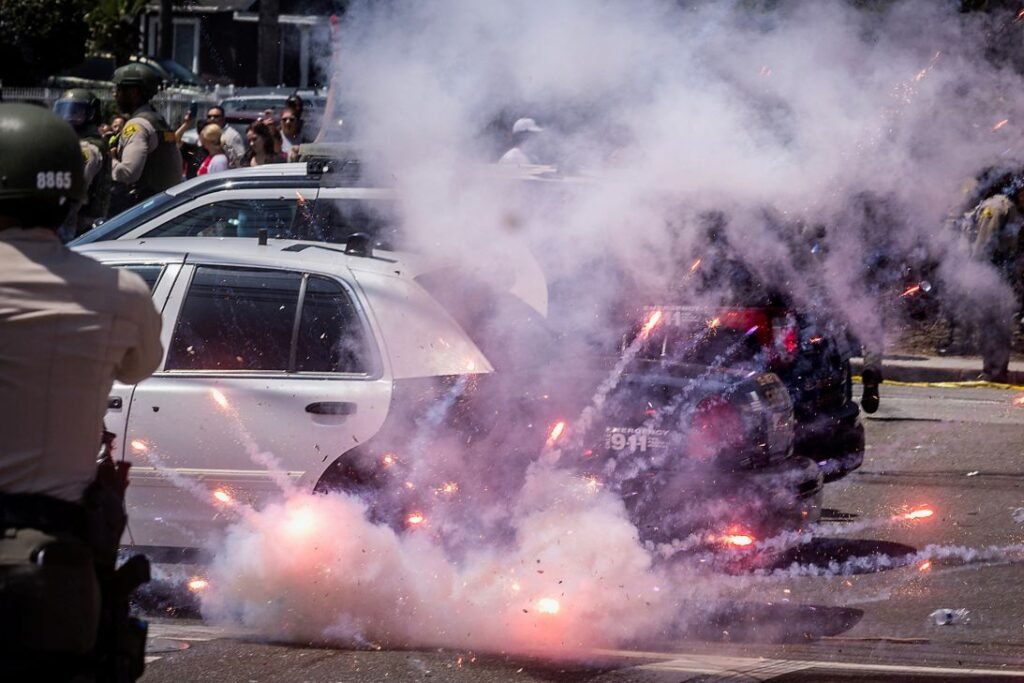
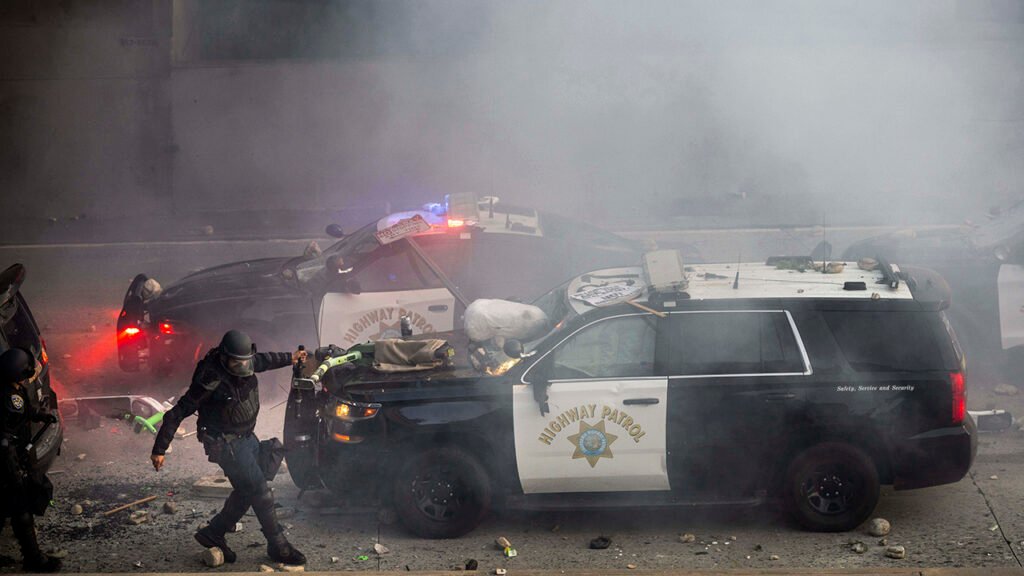
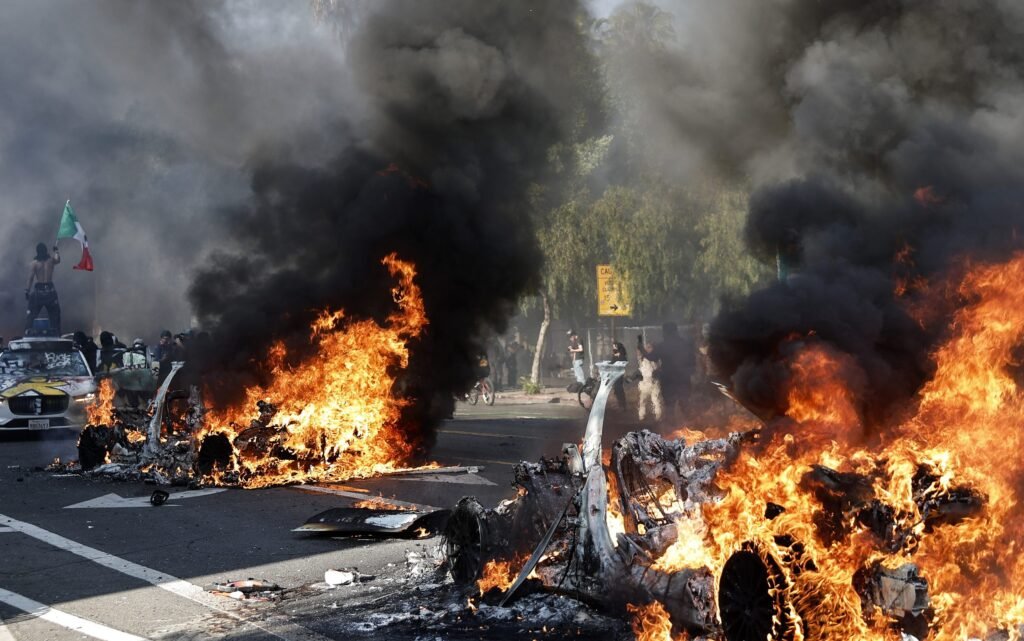
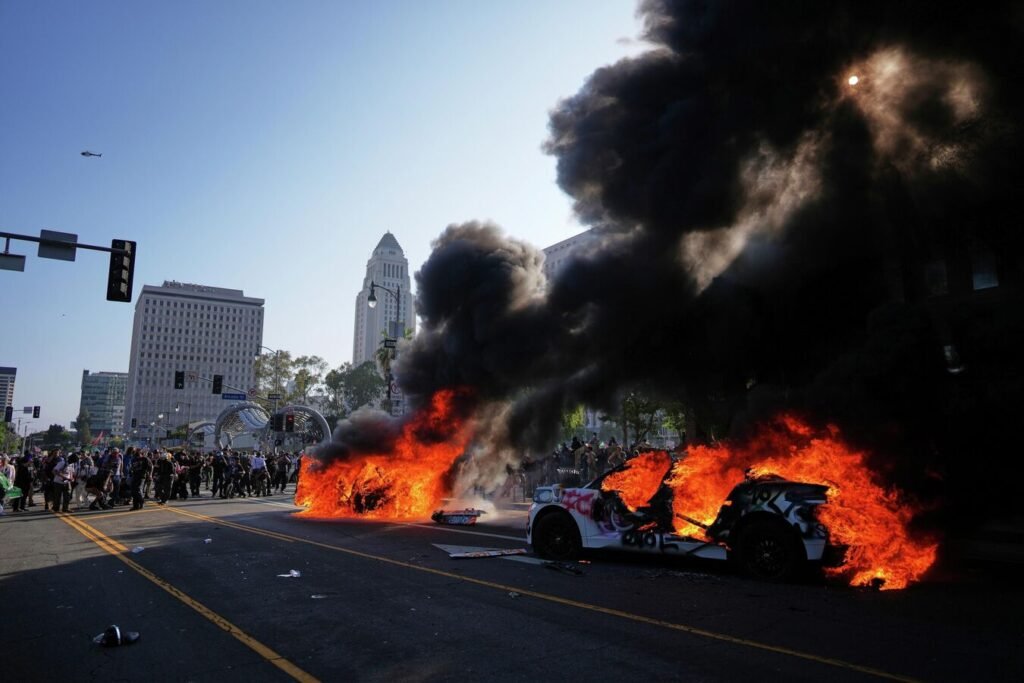
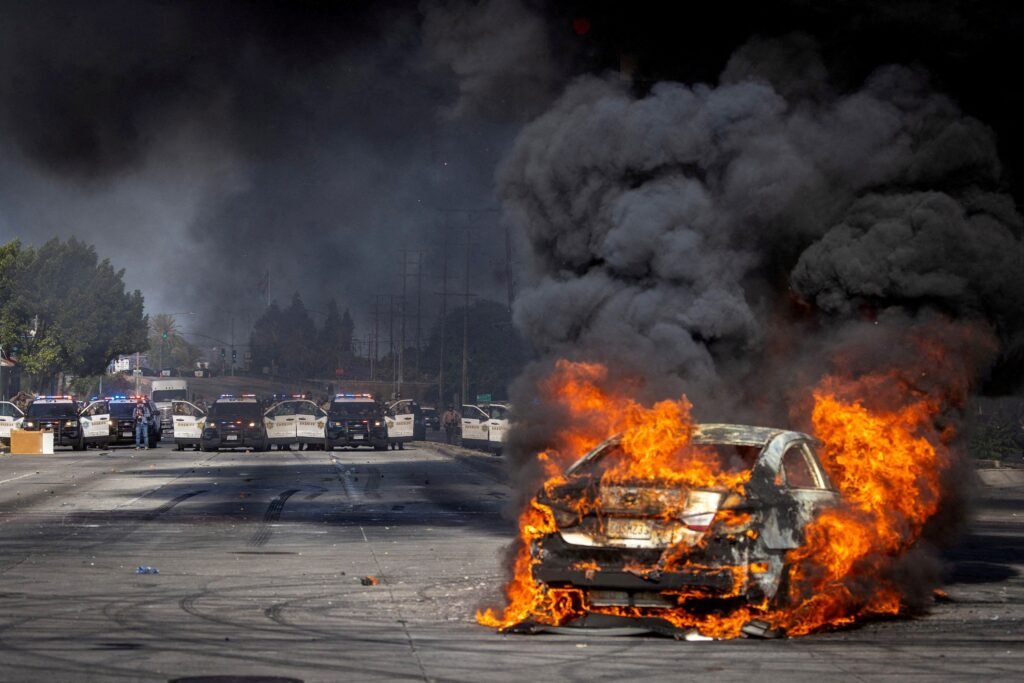
As news of the raids spread, protests erupted across Los Angeles. Thousands took to the streets in spontaneous acts of defiance, blocking ICE vans and clashing with law enforcement. The scene outside the Ambiance factory was replicated in neighborhoods like Paramount and Boyle Heights, where community members organized on the spot to resist. The protests quickly grew into the tens of thousands. Protesters — many of them workers, students, and immigrants — faced off against heavily armed police and ICE agents wielding flashbang grenades, rubber bullets, and tear gas.
The arrest of David Huerta, president of SEIU–USWW, during a protest sent shockwaves through the labor movement. After being tackled and hospitalized by police, Huerta was detained and charged with federal felonies. The attack on such a prominent union leader — in a state where SEIU alone represents over 700,000 workers — underscored the state’s readiness to criminalize even moderate labor leaders. In response, unionists began calling for national solidarity and mass action, recognizing that the attack on undocumented workers was an attack on the working class as a whole.
Federal Power Grab and Political Theatre
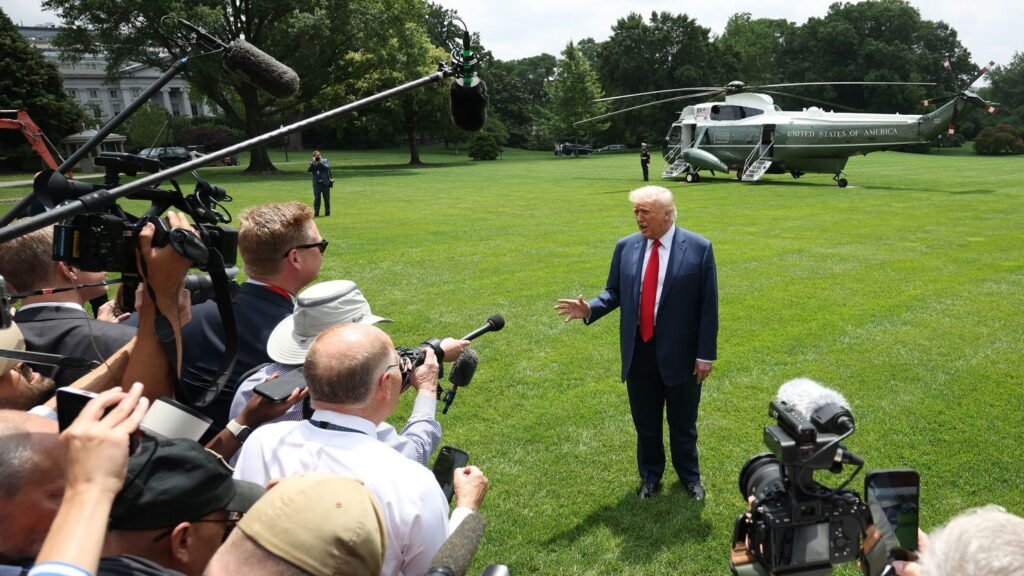
Rather than de-escalate, the Trump administration intensified the crisis. Without a request from state officials, Trump federalized the National Guard and deployed 2,000 troops to Los Angeles. His “border czar” Tom Homan even threatened to arrest Mayor Karen Bass and Governor Gavin Newsom if they resisted. Secretary of Defense Pete Hegseth signaled that active-duty Marines could be deployed from Camp Pendleton, framing the unrest as an insurrection.
Vice President J. D. Vance and other administration officials fanned the flames on social media, labeling demonstrators as “foreign mobs” and calling for more aggressive policing. Trump used his Truth Social platform to call protesters “thugs,” demand arrests, and claim he would “liberate” Los Angeles from a supposed “migrant invasion.” These statements were not merely rhetorical — they were part of a strategy to justify authoritarian intervention under the guise of restoring order.
But this “order” was never disrupted by immigrants or workers. The crisis was deliberately provoked. As Councilmember Hugo Soto-Martinez put it, Trump “manufactured this spectacle” to shift blame for economic hardship onto immigrants, rather than the billionaire class that continues to amass wealth while workers suffer.
Exploitation as Policy
At the heart of the crisis lies the economic calculus of repression. Trump’s administration has deep ties to private prison corporations like GEO Group and CoreCivic — entities that directly profit from immigrant detention. These companies, having bankrolled Trump’s campaigns, now reap the benefits: new contracts, new detention facilities, and a lucrative influx of federal funding. GEO Group alone anticipates $1 billion in added annual revenue.
This is not an aberration of capitalism — it is its logical conclusion. As Milton Friedman once explained, “Immigration is good only as long as it is illegal.” Undocumented workers are doubly useful to capitalists: they provide a hyper-exploitable labor pool while serving as scapegoats for economic distress. Bosses use immigration status as a weapon to suppress wages and crush union activity. As Marissa Nuncio of the Garment Worker Center said, “It’s exploitative industries and draconian immigration policies that make immigrants vulnerable — not immigrants themselves.”
Democrats’ Complicity
While Trump’s tactics are overtly brutal, the Democratic Party’s role in sustaining this system is no less significant. California’s Democratic leaders decry ICE raids publicly while enabling them quietly. The LAPD, under the guise of “traffic enforcement,” facilitated ICE operations. Governor Newsom cut funding for legal aid to undocumented children and proposed barring immigrants from healthcare access through Medi-Cal.
Despite claiming California as a “sanctuary state,” Democrats have shown no will to challenge the deportation machine itself. Even President Biden and his predecessor Barack Obama deported more immigrants than Trump did in his first term. As workers face raids, detentions, and family separations, Democratic officials offer symbolic resistance while reinforcing the structural foundations of the immigration regime.
A Working-Class Answer
The events in Los Angeles show both the brutality of the state and the resilience of its opposition. Workers, immigrants, students, and labor leaders united in defense of their communities — but spontaneous courage alone is not enough. What’s missing is organization: not just protest, but political power.
The Revolutionary Communists of America and other radical forces argue that to defeat ICE and its backers, the working class must build neighborhood defense committees, strike networks, and a revolutionary party capable of coordinating national action. As in 2020, when National Guard soldiers began questioning their orders, today’s military deployments reveal internal contradictions. The state fears the working class because it knows that when organized, it cannot be stopped.
The protests in Los Angeles could become the flashpoint for a broader movement — one that links immigrant rights to labor rights, and both to a systemic challenge against capitalism. Trump hopes to crush this possibility with violence and fear. But history shows that repression often begets resistance.