

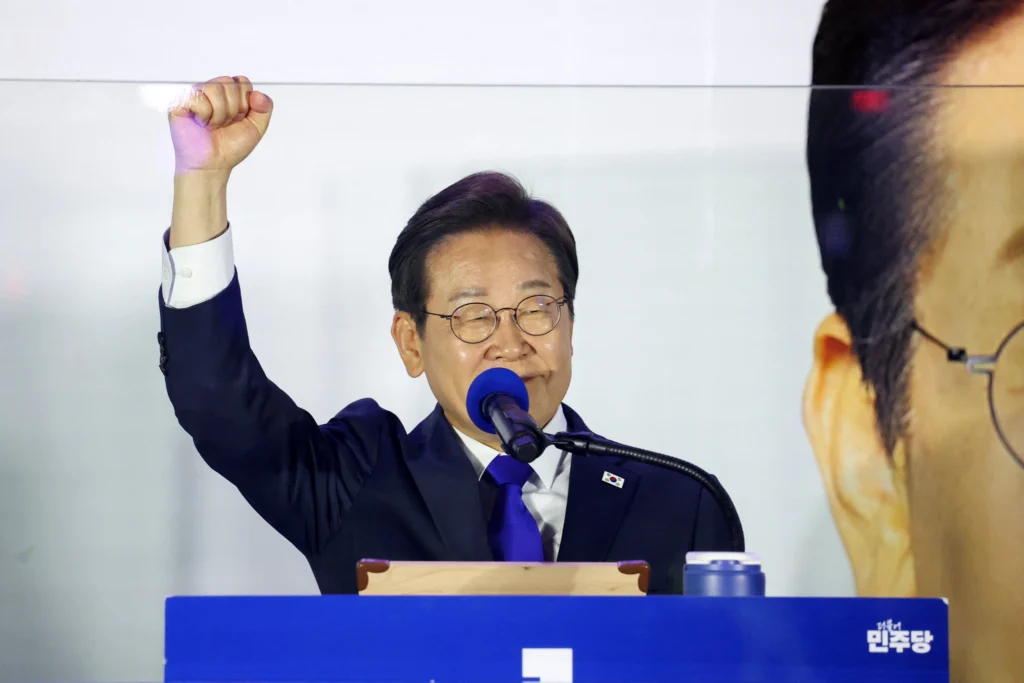
South Korea’s most recent snap presidential election marked a dramatic turn in the nation’s turbulent political saga. On June 3, Lee Jae-myung, a populist lawyer and longtime figure in the liberal Democratic Party (DPK), clinched the presidency in the wake of former President Yoon Suk-yeol’s failed coup attempt. While Lee’s victory was expected, it unfolded against the backdrop of a deeply fragmented political landscape, characterised by the collapse of democratic norms, the consolidation of neoliberal governance, and the emboldening of a far-right movement nurtured by misogyny, religious fundamentalism, and economic anxiety.
Though Lee’s win offered a veneer of stability, it is clear that South Korea’s political crisis is far from over. The conservative opposition is fractured but persistent, the far right is gaining strength among young male voters, and the left remains structurally marginalised and internally divided.
Amid these dynamics, labour organisations and nascent left-wing political forces face the challenge of charting a path forward in an increasingly hostile environment
A Fragile Victory for Lee Jae-myung
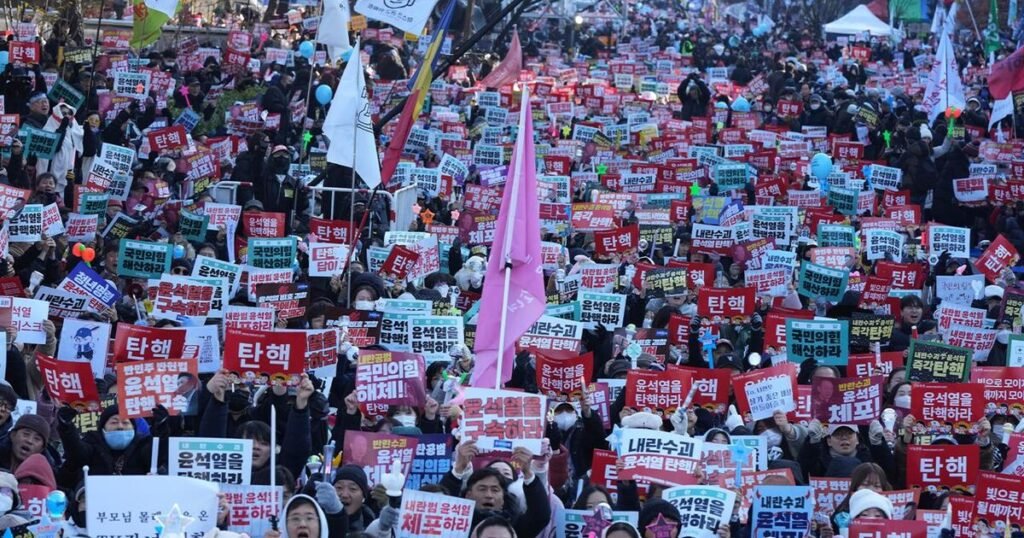
Lee secured the presidency with 49.4 percent of the vote — an impressive figure given the context, yet deceptive in its implications. The snap election followed Yoon’s attempted seizure of power, which spurred mass protests and a record-high voter turnout of nearly 80 percent. Yet, Lee’s mandate rests on an uneven foundation. His margin of victory shrinks drastically outside the Democratic Party’s southwestern strongholds. In the capital Seoul — the country’s economic and political epicentre — the combined vote for conservative candidates edged past Lee’s total.
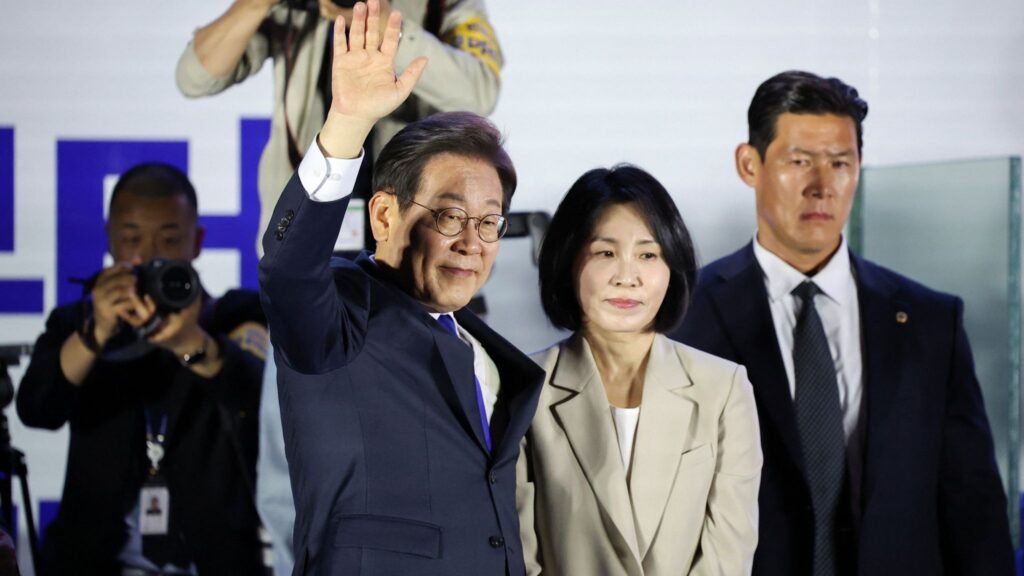
Moreover, Lee’s image as a self-made politician — one who overcame poverty, manual labour, and a work-related injury to become a successful lawyer and public official — has been overshadowed by longstanding corruption allegations. Despite his populist posturing, Lee’s political practice reveals a transactional style rooted in gentrification, clientelism, and insider networks. His appointments since taking office have reaffirmed this pattern, as he installed trusted loyalists instead of bridging political divides through bipartisan governance.
The Rightward Drift of the Electorate
What stands out most in this election is not Lee’s victory, but the consolidation of the far right, particularly among young men. More than 75 percent of male voters in their twenties supported ultra-conservative candidates. This generational realignment reflects not merely disaffection with liberalism but an embrace of reactionary narratives that fuse economic resentment, anti-feminism, and authoritarian nostalgia. The Reform Party — a splinter from Yoon’s People Power Party (PPP) — captured this sentiment and came in third, further fragmenting the conservative bloc.
Meanwhile, young women, especially in their twenties and thirties, overwhelmingly supported Lee or the minor left-wing candidate, Kwon Young-guk. This gendered polarisation in voting patterns underscores deeper social fissures: over inequality, patriarchy, and cultural representation. Despite the progressive leanings of many female voters, no major party platform genuinely reflected a commitment to systemic feminist reform or robust social democracy.
Lee’s Politics: Populist in Form, Neoliberal in Substance
Despite global media framing Lee as South Korea’s answer to Bernie Sanders, his record speaks to a fundamentally pro-business orientation. While his tenure as mayor and governor included populist gestures — such as limited universal income pilots — these initiatives were symbolic and short-lived. Lee supports deregulating labour markets, extending legal working hours, and further integrating South Korea into volatile global finance.
The Democratic Party he leads has long abandoned its roots in the pro-democracy movement of the 1980s. Today, it is dominated by career politicians, technocrats, and a class of upwardly mobile professionals who distinguish themselves from the chaebol elite not in ideology but in the mode of corruption — preferring complex equity schemes over simple bribery. Far from offering a left-wing alternative, the DPK represents a more palatable, PR-friendly version of neoliberal governance.
Geopolitical Pressures and Militarisation
Externally, Lee’s presidency is marked by mounting geopolitical pressures. Washington’s rivalry with Beijing has placed South Korea in a precarious position. The country’s decades-long balancing act — maintaining economic ties with China while anchoring its security posture to the United States — is becoming untenable. Trump-era officials and MAGA-aligned operatives have even meddled in South Korean electoral affairs, using unfounded allegations of Chinese interference to tether Seoul more tightly to U.S. strategic objectives.
Domestically, the spectre of renewed conflict with North Korea looms large. As inter-Korean communications have collapsed, a new arms race has emerged — one shaped by asymmetric warfare and fuelled by Russia’s military support for Pyongyang in exchange for munitions and manpower in Ukraine.
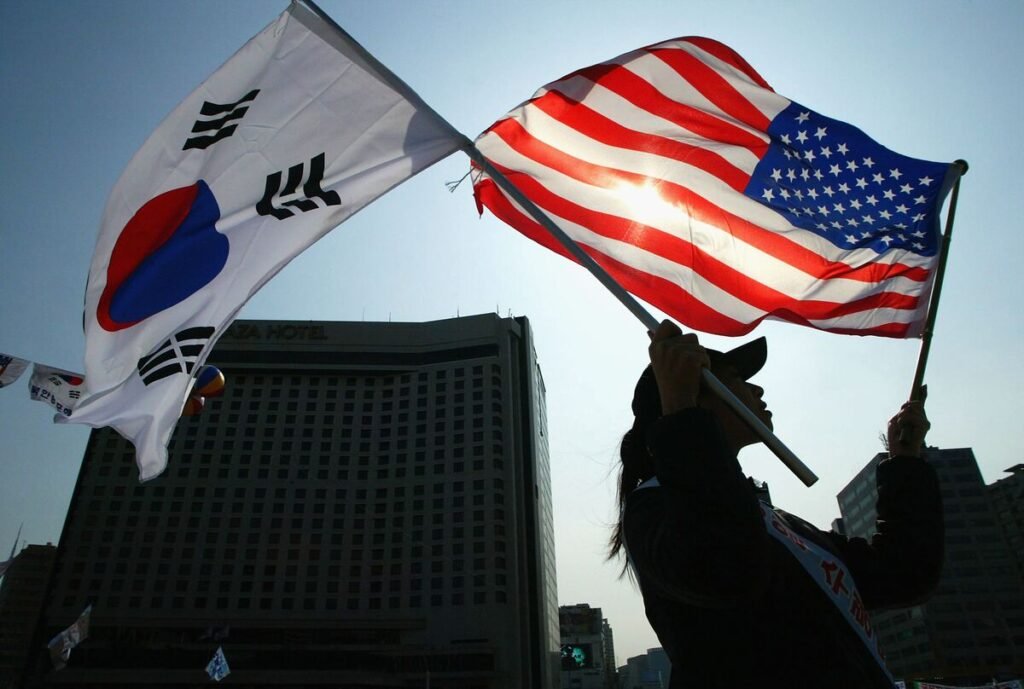
The North is rapidly modernising its conventional forces, while the South debates acquiring its own nuclear weapons.
With Camp Humphreys — the largest U.S. overseas military base — located on South Korean soil, a regional war involving Taiwan would immediately implicate Seoul. The convergence of these dynamics poses an existential threat to peace on the Korean peninsula and demands a foreign policy alternative that no major party is prepared to deliver.
The Divided and Marginalised Left
Within this volatile context, South Korea’s left remains fractured and institutionally weak. Labour unions such as the Korean Confederation of Trade Unions (KCTU), which played a vital role in resisting Yoon’s coup, have failed to build lasting political power. KCTU president Yang Kyung-soo’s attempt to unilaterally endorse Lee — a break from the union’s stated aim of building an independent workers’ party — provoked backlash from within and ultimately fell flat.
Meanwhile, the minor left candidate Kwon Young-guk ran a principled but underfunded campaign under the banner of a hastily assembled Democratic Labor Party — an homage to the early 2000s political formation that once secured parliamentary representation.
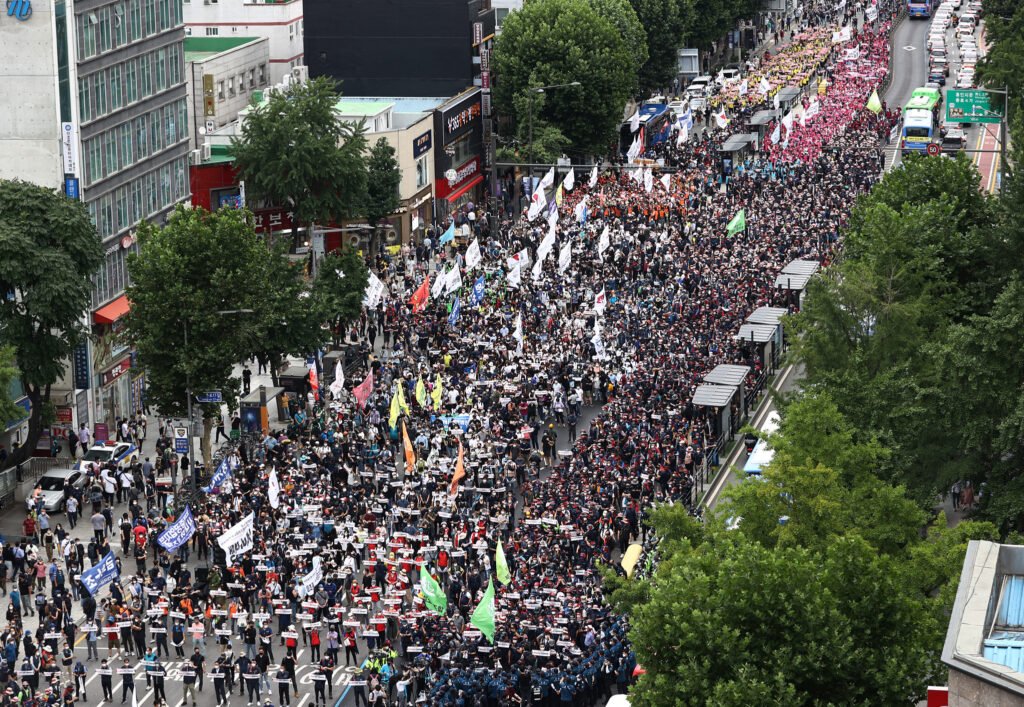
Despite organisational limitations, Kwon garnered nearly 1 percent of the vote and inspired a wave of small donations, especially from young women, in the aftermath of the election. This unexpected groundswell points to a latent desire for a genuine left alternative — one grounded in feminism, labour rights, and social justice.
Yet, the institutional obstacles remain enormous. The electoral system favours large parties, public discourse is saturated with Cold War rhetoric, and legal restrictions limit coalition-building among left groups. Moreover, intra-left conflicts — including the Democratic Party’s deals with the left-nationalist Jinbo Party — often undermine strategic coherence.
The Road Ahead
If there is any lesson from the recent upheaval, it is that no change will come from the Democratic Party. The centre cannot hold, and the far right is rapidly organising. The only viable path forward for South Korea’s left is to build an autonomous movement — one that does not mistake liberal populism for progressive politics, and that centres the demands of workers, women, and the dispossessed.
This will require rebuilding trust within the labour movement, deepening ties with social movements, and cultivating new political formations capable of both contesting elections and mobilising mass action. South Korea’s political crisis is not simply about corrupt leaders or flawed parties; it is a systemic failure — one rooted in neoliberal capitalism, militarised nationalism, and democratic decay.
The left must seize this moment — not with nostalgic slogans, but with a clear vision for a new republic, built from below.