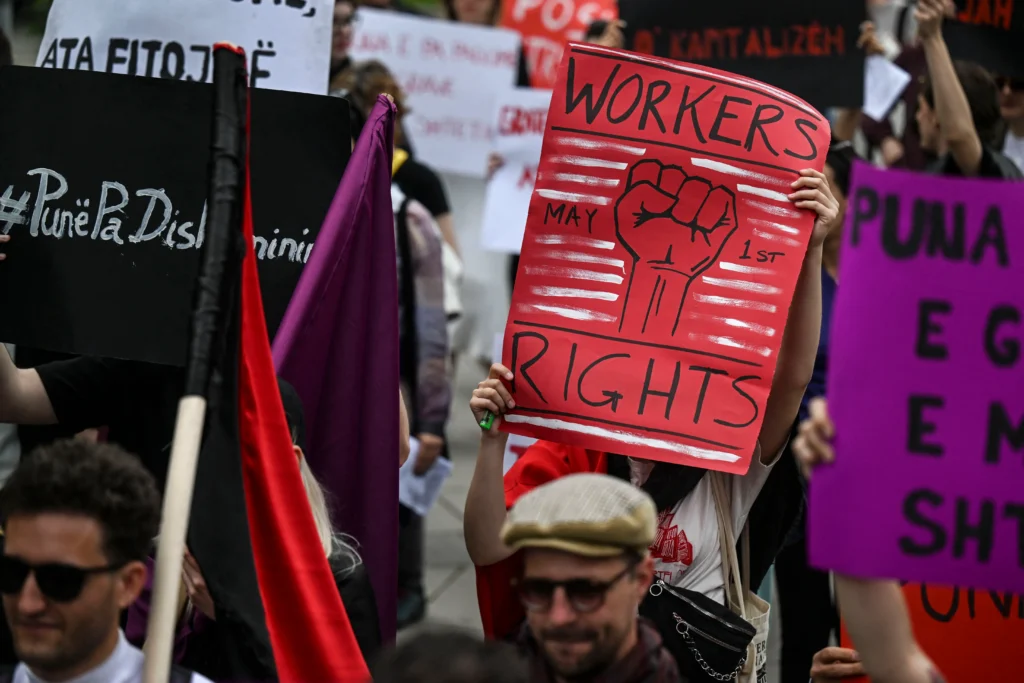

The international workers’ holiday of May 1st retains its character as a critical focal point of the global class struggle. In 2025, militant mobilizations erupted in numerous countries, reflecting deepening discontent with the capitalist system. Notably, demonstrations in Serbia and Turkey highlighted the continuing contradictions between labor and capital, as state forces responded with repression, reaffirming the historical role of the bourgeois state as the instrument of class domination.
These events, while significant, should not be interpreted as isolated phenomena. They express the systemic crises inherent within global capitalism. Since the 2008 financial collapse, the capitalist world economy has failed to achieve any stable recovery. Structural stagnation, intensifying inequality, and a proliferation of imperialist wars and environmental destruction have defined the current epoch. These objective conditions are ripe for revolutionary transformation; however, without subjective preparation—that is, without revolutionary leadership—the working class remains vulnerable to misdirection and defeat.
May Day must not be reduced to a ceremonial commemoration. It embodies the living tradition of proletarian internationalism and revolutionary defiance. The recent mobilizations demonstrate both the readiness of the masses to struggle and the acute absence of effective, revolutionary organization. Lenin’s dictum remains unassailable: “Without revolutionary theory there can be no revolutionary movement.” It follows that the central crisis facing the international proletariat today is a crisis of leadership.
Organizing May Day as a consciously revolutionary act is crucial for advancing the working-class movement. It is not enough to allow spontaneous protests or symbolic marches. Revolutionary must take the initiative to:
- Repoliticize May Day: Reassert May 1st as a day of internationalist, anti-capitalist, and anti-imperialist struggle, countering efforts to depoliticize or dilute its revolutionary meaning.
- Link Immediate Demands to Strategic Goals: While addressing immediate issues like wages, working conditions, and democratic rights, Marxists must consistently highlight the necessity of socialist revolution as the only enduring solution.
- Forge Unity Through Struggle: May Day must serve as a unifying platform for diverse sectors of the proletariat, including organized labor, unemployed workers, migrant laborers, women, youth, and oppressed nationalities.
- Strengthen Organizational Structures: Every May Day should be used to build lasting organizational capacity—developing workers’ councils, strengthening trade unions under revolutionary leadership, and expanding the influence of the vanguard party.
- Raise Revolutionary Consciousness: Educational efforts, mass agitation, and political training must accompany mobilizations, turning momentary activism into sustained revolutionary engagement.
The events of May 1st, 2025, reaffirm the necessity of reconnecting contemporary struggles with the revolutionary traditions of the working class. Without Marxist-Leninist leadership, spontaneous movements, no matter how heroic, will dissipate or be co-opted by bourgeois forces. Historical experience—from the Paris Commune to the October Revolution to the successes and failures of twentieth-century socialism—demonstrates that revolutionary outcomes hinge upon the existence of a prepared, theoretically grounded, and militant proletarian vanguard.
The present period, marked by renewed mobilizations, signals a reawakening of class consciousness. Yet this potential must be consciously developed. Revolutionary transformation will not be the inevitable byproduct of economic crisis or mass indignation; it requires disciplined political struggle.
May Day must continue to serve as a clarion call for world proletarian revolution. Revolutionary must meet this historic responsibility with the urgency and seriousness it demands. Organizing May Day as a revolutionary project is not merely a tradition—it is a necessity in the struggle for the emancipation of humanity.