
Earlier this year, a significant rift emerged when British negotiators withdrew from discussions regarding participation in the European Union’s flagship defense fund. This decision followed a quoted access fee of €6 billion, a stark contrast to the €10 million fee previously secured by Canada. British Foreign Secretary Yvette Cooper explicitly justified the withdrawal by stating that the United Kingdom would only participate in agreements offering genuine value for money. While this fee dispute may appear as a minor administrative disagreement, it serves as a profound indicator of the underlying design and optimization of the €150 billion Security Action for Europe (SAFE) fund.

SAFE was established to address a critical vulnerability: the European defense-industrial base’s overreliance on non-EU suppliers. To counteract this, the fund mandates that a minimum of 65 percent of a weapon’s value must originate from within the EU, the European Economic Area (EEA), or Ukraine. In a narrow sense, the initiative is succeeding, evidenced by the mobilization of capital and the expansion of manufacturing facilities. However, a rigid interpretation of this rule has effectively priced out the United Kingdom, the only European military possessing genuine force projection capabilities.

The Scale of Ambition and Existing Gaps
There is no questioning the immense scale of Europe’s current defense-industrial build-up. Beyond the mobilization of national budgets facilitated by the European Commission’s fiscal-flexibility initiatives, the SAFE mechanism provides €150 billion in joint loans. Furthermore, the European Defence Industry Programme (EDIP) contributes an additional €1.5 billion in direct funding. This architecture is designed to mobilize approximately €190 billion by 2036 across five major joint projects designated by the Commission. These strategic projects include drones and counter-drone systems, space defense, maritime and seabed defense, air and missile defense, and security operations along the eastern flank. Each of these initiatives draws participation from roughly eighteen member states, with Ukraine included in four out of the five projects.
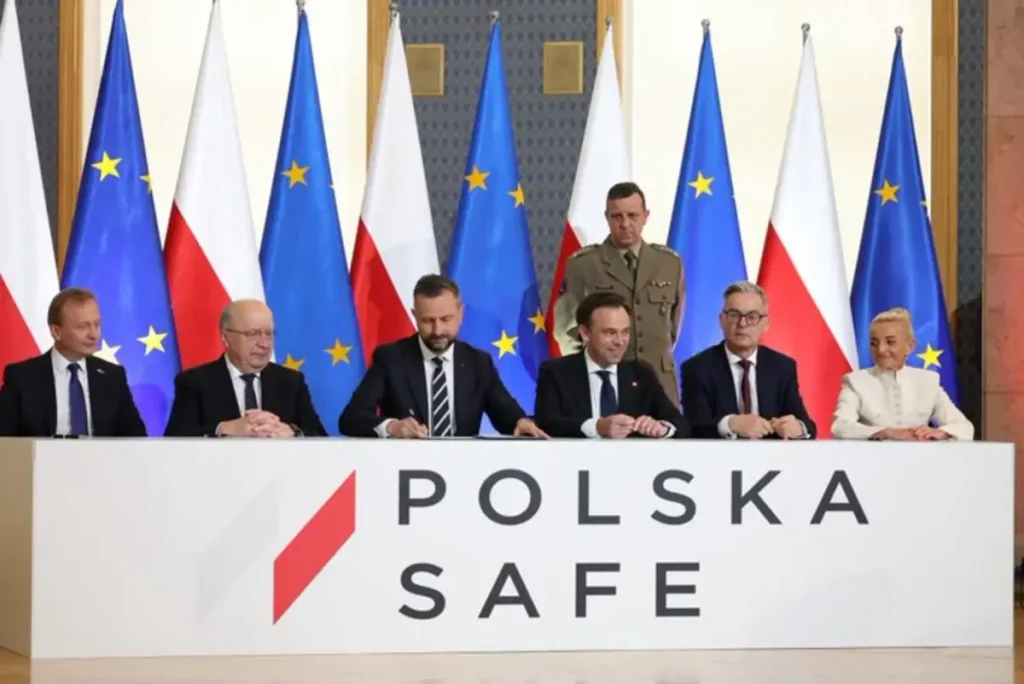
Poland has emerged as a primary test case for this funding model, currently allocating nearly 4.8 percent of its GDP to defense—the highest ratio within the NATO alliance. This massive spending will determine whether EU funding effectively builds a shared European defense capacity or merely inflates isolated national arsenals. Despite these ambitions, a significant gap remains between financial commitments and actual output. For instance, earlier this year, Germany’s air-defense missile stocks were reported to be critically low, even as the nation ramps up its artillery shell production. Additionally, EDIP’s projected delivery timeline spans from 2028 to 2033. This timeline lags behind the NATO planning assumption—articulated by General Alexus Grynkewich—that European allies must be prepared to lead their own continental defense by 2035.
Industrial Concentration and Financial Market Signals
The influx of European defense capital is predominantly concentrating within a select group of prime contractors that possess the requisite balance sheets and manufacturing capacity to absorb such massive contracts. Rheinmetall, the German manufacturer of armor and artillery shells, is the most prominent beneficiary, with projected sales growth reaching up to 45 percent by 2026. KNDS, a Franco-German manufacturer of artillery and tanks, boasts a €33 billion order backlog and an expected revenue growth of 30 percent. Other major players sitting in this top tier include Leonardo, Thales, and Saab. Smaller national suppliers generally enter this ecosystem merely as subcontractors to these giants, rather than as direct, independent beneficiaries of the funding surge.
However, the financial markets are demonstrating caution. Mid-year, KNDS suspended its planned public listing. This suspension was not due to a weakening in demand, but rather because institutional investors declined to pay the high valuation multiples suggested by the company’s pre-listing narrative. This market reaction serves as a critical indicator: capital markets are shifting away from rewarding mere political announcements and are increasingly demanding concrete evidence of cash flow, profit margins, and actual factory throughput.
The Polish Procurement Contradiction
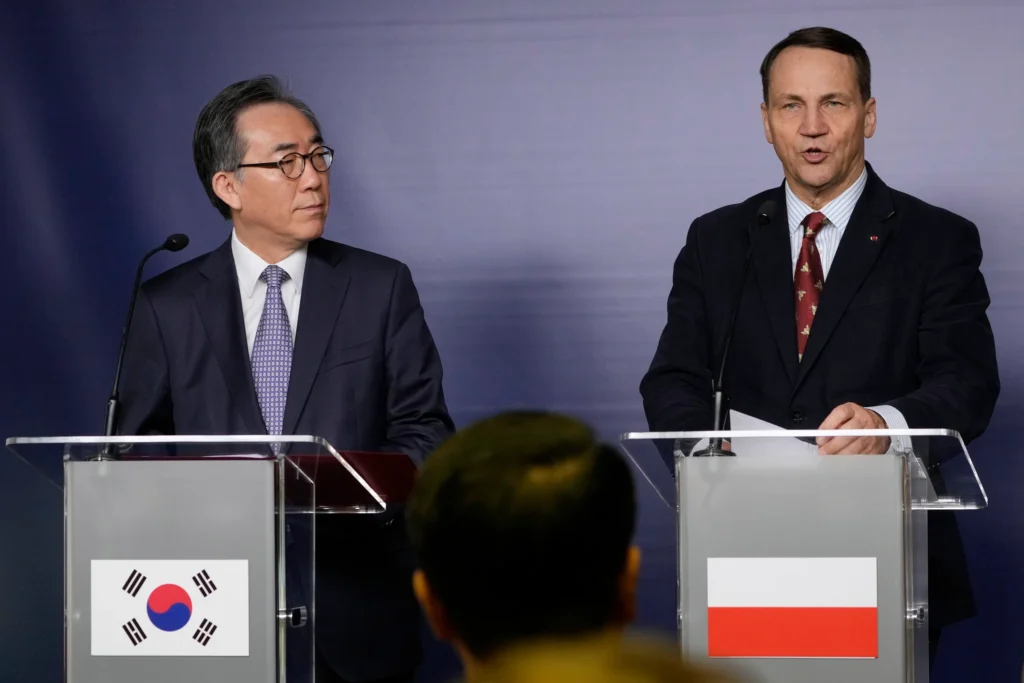
Poland provides a highly revealing case study regarding the actual destination of new manufacturing capacity. The nation is pursuing a roughly $6.5 billion program to acquire up to 1,000 K2PL tanks in collaboration with South Korea’s Hyundai Rotem. This initiative localizes final assembly at the state-owned Bumar-Łabędy plant located in Gliwice. The project targets a production output of up to 50 tanks annually starting in 2028. It is projected to create more than 10,000 jobs. The program also carries an explicit ambition to eventually re-export production and maintenance capacity to other European operators.
While this represents the exact type of manufacturing-hub development that SAFE aims to incentivize, the program is fundamentally built upon South Korean intellectual property and design. This reliance constitutes precisely the category of non-EU dependency that the 65-percent local-content rule was designed to eliminate. Consequently, the EU’s flagship autonomy fund and Poland’s flagship rearmament program are pulling in contradictory directions. Warsaw is managing to navigate both simultaneously because regulatory rules from Brussels remain flexible for politically crucial national procurement, a flexibility that was plainly absent during Britain’s participation fee negotiations.
While defenders of this approach argue that keeping assembly, jobs, and long-term maintenance expertise within EU territory is a defensible strategy for a mid-sized industrial base, this does not resolve the broader issue of institutional coherence. The 65-percent rule is being strictly enforced against the United Kingdom—the ally with the deepest industrial and operational integration with continental Europe, whose forces train and manufacture more closely with European militaries than any other non-EU state. Conversely, the rule is interpreted flexibly for platforms assembled domestically but based entirely on foreign designs. If measured solely by euros spent in European factories, strategic autonomy appears to be advancing. However, if the goal is a mutually reinforcing defense-industrial base rather than a fragmented collection of parallel national projects sharing a funding label, the situation is far less stable.
Institutional Incoherence and Parallel Procurement
This structural incoherence is increasingly affecting the organization of defense procurement itself. As the EU’s proprietary architecture—including SAFE, EDIP, and the “buy European” amendments anticipated in the 2026 revision of the Defence Procurement Directive—establishes boundaries around EU members, the EEA, and Ukraine, excluded or partially included allies are shifting their joint purchasing to NATO channels. The NATO Support and Procurement Agency convened its inaugural Innovation Procurement Forum in July. Demand from Nordic and Baltic states is increasingly being aggregated through looser vehicles, such as the UK-led Joint Expeditionary Force.
Historically, NATO-level pooling was intended to complement EU industrial policy, not serve as a substitute for it. Currently, however, Europe is operating two loosely coordinated procurement tracks: one defined by EU membership and strict content rules, and another driven by alliance membership and operational urgency. There is currently no robust evidence to suggest that the timelines, capacity, and contracts across these two tracks are converging rather than merely duplicating efforts.
Future Scenarios for European Defense
Industry analysts project three potential trajectories for the European defense sector.
In the base case scenario, estimated at a 55 percent probability, funding from EDIP and SAFE continues to concentrate heavily within the existing tier of national-champion prime contractors, establishing Poland and Germany as the continent’s primary manufacturing hubs. The United Kingdom remains formally excluded from SAFE. London subsequently deepens its bilateral defense-industrial agreements with Italy, Germany, and Norway, focusing on artillery, naval vessels, and fighter jets. NATO procurement channels absorb the UK-inclusive and cross-Atlantic cooperation that EU content rules complicate. By the early 2030s, Europe possesses significantly more production capacity, but suffers from a highly segmented industrial base rather than the unified single market envisioned by Brussels.
In a downside case scenario, the investor skepticism that halted KNDS’s public listing spreads across other prime contractors as execution risks become undeniable. This skepticism could be triggered if EDIP’s 2028–2033 delivery window fails to align with NATO’s 2035 readiness assumption. Politically motivated national procurement initiatives—such as Poland’s integration of Korean tank designs alongside EU content rules—multiply, resulting in fragmented rather than consolidated production standards. By the end of the decade, Europe possesses more announced capacity than actual fielded military capability. The funding architecture remains compromised by an unresolved negotiating dispute that successfully priced out Europe’s most capable non-EU military.
In an upside case scenario, the five joint EDIP projects successfully mature into a genuinely shared defense capability across the participating eighteen states, Norway, and Ukraine. Brussels and London discreetly negotiate a bespoke defense-industrial arrangement that entirely circumvents the SAFE fee dispute. EU industrial-policy mechanisms and NATO procurement channels begin to converge on shared timelines and suppliers. This convergence produces a pluralistic but highly interoperable European defense-industrial base by the early 2030s.
Conclusion
The deployment of SAFE and EDIP demonstrates that Europe is highly capable of raising capital and expanding factory floors faster than it can establish a consensus on the ultimate purpose and boundaries of its defense-industrial base. While Poland’s tank plants and Rheinmetall’s artillery lines represent tangible progress, the fee dispute that alienated Britain is equally real. The simultaneous occurrence of these events strongly indicates that, in its current iteration, European “strategic autonomy” signifies theoretical independence from Seoul and Washington, while quietly facilitating the practical exclusion of London.
Moving forward, the critical metric to monitor is whether Brussels and London can forge a bespoke defense-industrial agreement before the first EDIP deliveries materialize in 2028. If British forces remain the most operationally integrated non-EU military on the continent while its industrial capacity remains formally excluded from SAFE, that structural gap will serve as the true measure of whether Europe has constructed a unified continental defense market, or merely a larger, disjointed collection of national enterprises operating side by side.