
A Historic Left-Wing Victory: France’s Nouveau Front Populaire Rises Against the Far Right
In a surprising turn of events, the Nouveau Front Populaire (NFP), a coalition of left-wing parties, has emerged victorious in France’s snap parliamentary elections, held on July 7. This alliance, hastily formed just weeks before the election, successfully blocked Marine Le Pen’s far-right Rassemblement National (RN) from gaining a majority in the National Assembly. Following a month of uncertainty and divisive campaigning, the NFP now stands as the largest bloc, setting the stage for a possible “cohabitation” government with President Emmanuel Macron’s administration.
Bringing together parties like France Insoumise, the Parti Socialiste, Les Écologistes, and the Parti Communiste Français, the NFP’s rapid success signals a shift in France’s political landscape. Its platform calls for an end to Macron’s unpopular policies, including a reversal of the 2023 pension reform, a redistribution of wealth, increased investment in public services, and official recognition of Palestinian statehood.
“This is a clear rejection of the far-right’s vision,” declared Jean-Luc Mélenchon, a central figure in the NFP, shortly after exit polls confirmed the alliance’s victory. “This election decisively marks the defeat of Macron’s coalition and signals a demand for change. Now, the president must respect the people’s voice and acknowledge the outcome,” Mélenchon continued, underscoring the NFP’s call for new leadership that reflects the coalition’s vision for France’s future.
A New Political Landscape and Uncertain Alliances
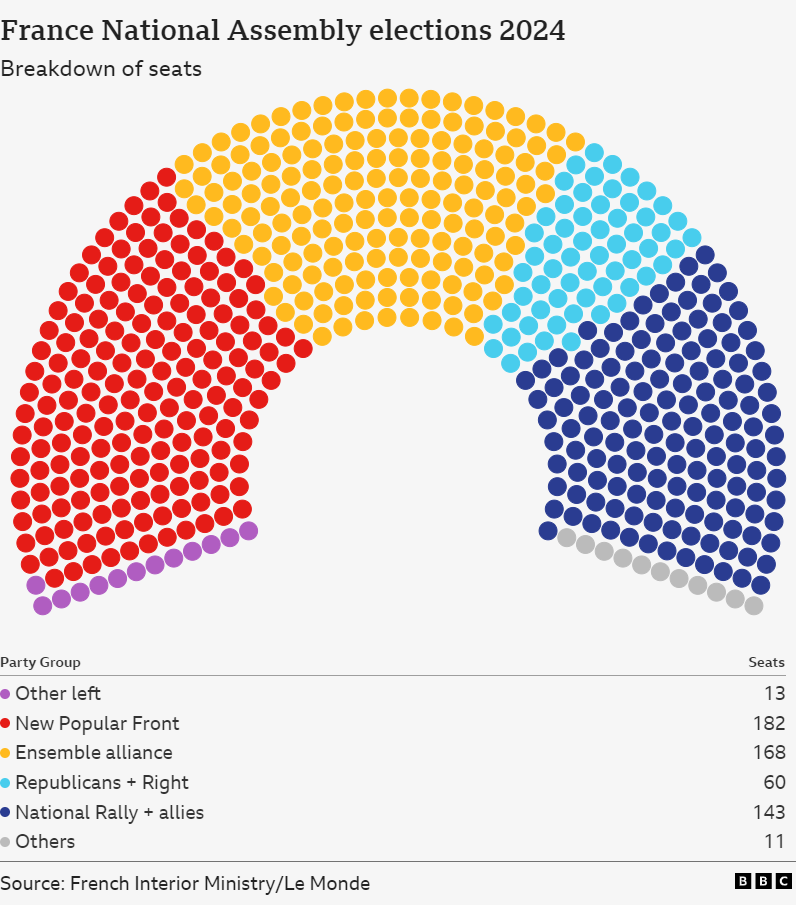
The election has resulted in a fragmented parliament with three distinct factions: the NFP on the left, Macron’s centrist bloc, and Le Pen’s far-right RN. This political division highlights a potential era of instability, as France’s major parties grapple with the challenges of coalition-building in a divided assembly. With 182 seats, the NFP has a slight lead over Macron’s centrist bloc with 168 seats, while the RN, despite its strong showing, holds 143 seats.
While Macron’s coalition suffered significant losses, reducing its presence in the assembly, the NFP’s success follows its initial formation under the New Ecological and Social Popular Union (NUPES) in 2022. The far right’s presence in parliament has also grown substantially, marking an increase from 88 seats in the previous assembly. Despite these gains, the RN fell short of expectations, losing to a resurgent left-wing alliance that leveraged the power of the “republican front” — a strategy wherein the NFP and centrist candidates coordinated to prevent far-right victories.
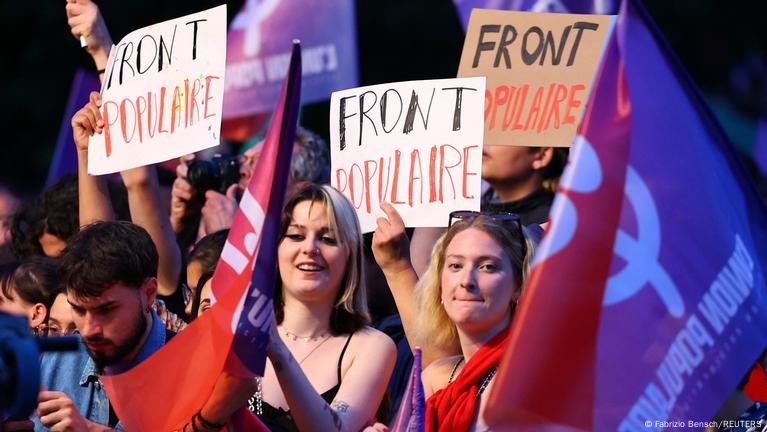
Across France, left-wing supporters celebrated into the night, gathering in Paris’s iconic Place de la République to mark what they see as a victory for democracy and anti-fascist values. “France is defined by its diversity, not by skin color or division,” proclaimed Mathilde Panot of France Insoumise, addressing the thousands who gathered. In contrast, the atmosphere among Le Pen’s supporters was somber, with RN leaders predicting that the left-wing coalition’s tenure would lead to instability.
Challenges Ahead: Navigating a Divided Assembly
Despite the NFP’s success, governing will not be straightforward. An absolute majority in the National Assembly requires 289 seats, leaving the NFP far short and reliant on alliances and possible compromises. While the NFP has promised to prioritize raising the minimum wage and freezing prices on essential goods, many of its objectives require parliamentary approval, where resistance from Macron’s bloc and the far-right RN is anticipated. The Senate, controlled by the center-right Républicains, also poses challenges for passing leftist reforms.
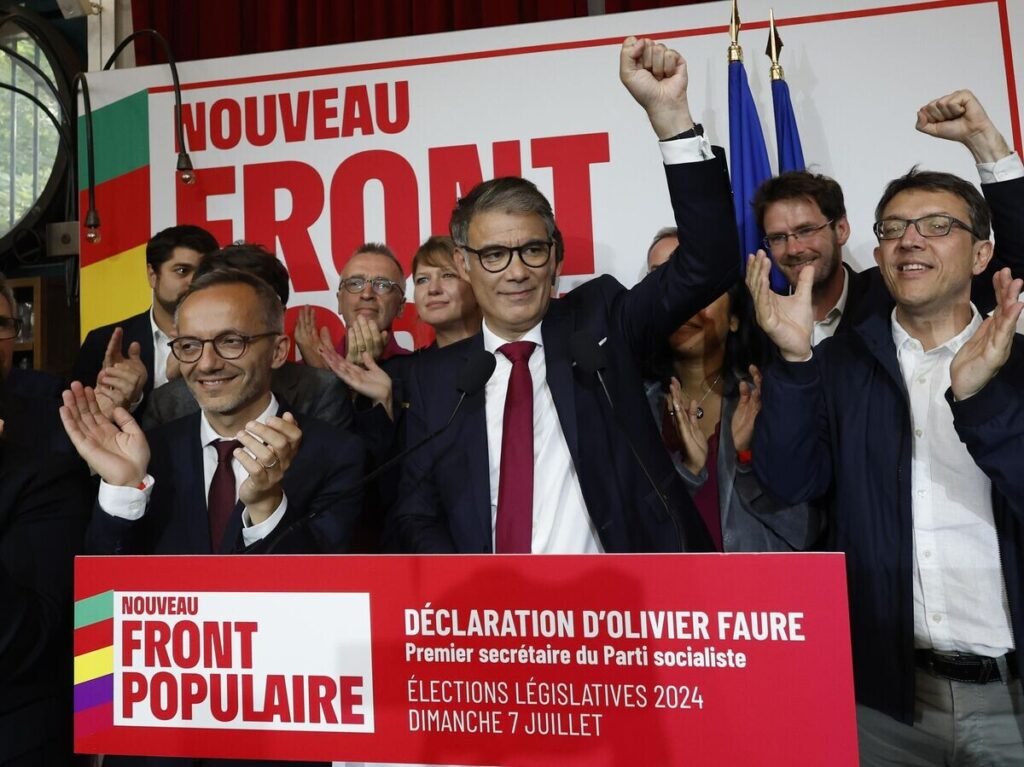
Parti Socialiste leader Olivier Faure reiterated the coalition’s commitment to its platform, stating, “Our guiding principle remains the NFP program, and we demand that the Macronist center respects this mandate by not siding with the far right to block our progress.” However, with Macron’s determination to preserve his influence, the NFP’s agenda faces potential resistance from both sides of the assembly.
France Insoumise, the most influential party within the NFP, remains committed to its progressive agenda. Nonetheless, some shifts in the internal balance within the coalition favor the Parti Socialiste, which gained seats and may push for compromises. Notably, François Ruffin, a former France Insoumise member, was re-elected as an independent after parting ways with Mélenchon’s leadership. Ruffin has voiced support for a coalition but insists on several conditions, including repealing pension reforms, restoring wealth taxes, and initiating constitutional reforms.
Macron’s Next Moves and the Future of the Left
Facing the prospect of a left-led parliament, Macron’s strategy appears aimed at dividing the left-wing coalition, delaying Prime Minister Gabriel Attal’s resignation to buy time for potential maneuvering. Macron’s decision to dissolve the National Assembly in June followed the RN’s strong performance in the European elections and was intended to strengthen his position. However, the unexpected strength of the NFP may complicate his efforts to regain control.
As Macron evaluates his options, France enters a period of political transition where leftist policies have a renewed mandate, and the NFP has the potential to steer France’s legislative agenda. The future will depend on how effectively the NFP can balance its ambitions with the reality of a divided parliament, where opposition forces remain formidable and Macron’s centrist bloc could prove an unpredictable ally or adversary.