

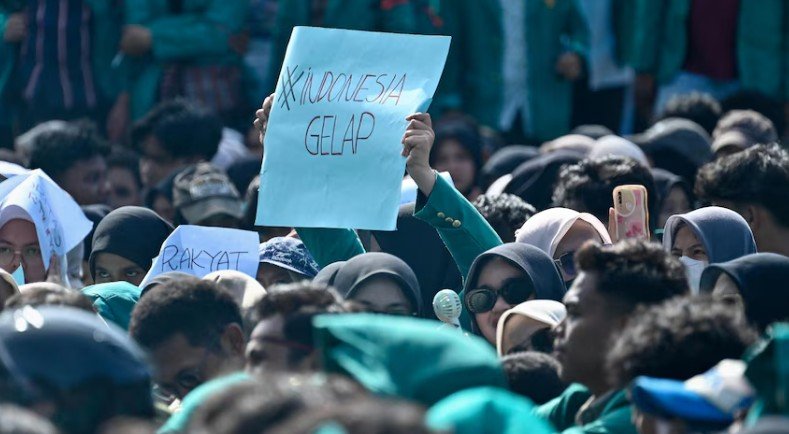
Indonesia is once again witnessing a significant wave of resistance, led primarily by students who have positioned themselves at the forefront of a growing movement against the government’s austerity measures. On February 17, tens of thousands of university students across the country took to the streets to express their opposition to recent budget cuts and economic policies implemented by President Prabowo Subianto’s administration.
What began as scattered demonstrations quickly spread into a national movement, culminating in a coordinated day of action on February 20. The protests, organized under the slogan #IndonesiaGelap (“Dark Indonesia”), stand in stark contrast to the government’s “Indonesia Emas” (“Golden Indonesia”) narrative, which promotes the illusion of economic progress and national strength. The slogan reflects the growing frustration among ordinary Indonesians who see not prosperity, but a dark future under Prabowo’s leadership.
Though the government initially boasted of stability following Prabowo’s electoral victory, this movement has shattered that illusion. Beneath the surface of apparent political control lies a deepening economic crisis and increasing social discontent, which the government can no longer contain.

The Illusion of Stability
Prabowo assumed office only four months ago, yet his government has already been confronted with mass opposition. This is not what Indonesia’s ruling class expected. Following his landslide election victory in November, Prabowo was able to form a super parliamentary coalition, uniting nearly all major political parties—including the newly established Labour Party—under the umbrella of the “Advanced Indonesia Coalition Plus” (KIM Plus). This coalition now controls 81% of the parliamentary seats (470 out of 580), leaving only the Indonesian Democratic Party of Struggle (PDI-P) outside the government.
Despite this dominance, cracks in the system are beginning to show. While mainstream media and government propaganda have painted a picture of stability, the economic reality is far more precarious. A January 2024 survey by Kompas newspaper showed that 81% of Indonesians approved of Prabowo’s government after his first 100 days—a record high. But approval ratings do not always reflect the real mood of the masses. As economic hardship deepens, the government is quickly losing its credibility.
The first signs of trouble emerged even before Prabowo officially took office. In August 2023, mass protests erupted against the amendment of election laws, which allowed President Joko Widodo’s youngest son to run for Jakarta governor. The widespread opposition forced the government to backtrack, marking a significant victory for the people. Now, just months later, a new and more intense movement is taking shape.
The Economic Crisis Behind the Protests
At the heart of this growing discontent is Indonesia’s worsening economic crisis. Prabowo’s government inherited massive debt from Jokowi, whose lavish infrastructure projects were financed through aggressive borrowing. Yet, despite this, the government must continue taking on more debt to sustain economic growth.
The problem? Global financial conditions have changed.
The era of cheap borrowing is over, and lenders are demanding that Indonesia prove its “fiscal discipline”—a euphemism for imposing harsh austerity measures on workers and the poor. To reassure creditors, the government has rushed to increase tax revenues and slash spending, regardless of the social consequences.
One of the most controversial policies was the proposed hike in value-added tax (VAT) from 11% to 12%, set to take effect on January 1, 2025. However, within days of announcing this policy, an online petition against the tax increase gathered 175,000 signatures, leading to a major backlash. Sensing potential unrest, the government abruptly backtracked, stating that the tax hike would only apply to luxury goods.
Having failed to raise taxes, Prabowo’s administration has turned to drastic budget cuts—a move that has sparked the current protests.


Austerity and Its Consequences
The first wave of cuts came in February 2024, with Rp 300 trillion ($19 billion) slashed from public spending. The cuts were indiscriminate—hitting vital public services, education, and labor programs:
- Labour Ministry: 57% budget cut
- Public Works: 55% cut
- Elementary Education: 20% cut
- Higher Education: 40% cut
- Anti-Corruption Agency (KPK): 15% cut
- Ministry of Human Rights: 35% cut
- Ministry of Cooperatives: 32% cut

These cuts have already begun severely impacting public services. For instance, university professors have been ordered to work from home for part of the day to reduce electricity costs. In other public offices, drinking water, toilet paper, and air conditioning have been restricted. Meanwhile, state meteorology agencies—responsible for tsunami and earthquake warnings—have suffered 50% budget reductions, raising fears of delayed disaster responses in a country prone to earthquakes and tsunamis.
At the same time, public sector workers—who were once seen as part of Indonesia’s middle class—are facing layoffs, worsening conditions, and stagnating wages. The government denies that any mass firings have occurred, claiming instead that short-term contracts simply weren’t renewed. However, for the thousands who have lost their jobs, this is merely a technical excuse for austerity-driven job cuts.
The ‘Dark Indonesia’ Movement
The opposition to these cuts has been led by students, whose protests under the #IndonesiaGelap (“Dark Indonesia”) banner reflect growing anger at government policies. The movement has broadened its demands, calling not just for the reversal of budget cuts, but also for:
- Free education
- Higher salaries for university lecturers
- Land reforms to support rural communities
- An end to police brutality
- Rejection of the military’s role in politics
After nearly a week of continuous protests, the movement temporarily retreated, but it remains far from defeated. The students still enjoy widespread public support, even if the broader working class has not yet joined the struggle en masse.
This is the key challenge: Students alone cannot defeat the government. For this movement to succeed, it must expand beyond universities and into workplaces, factories, and public sector offices. If workers begin coordinating strikes and mass workplace actions, the government will face an existential crisis.


A Government Standing on Shaky Ground
The Mitsotakis government in Greece recently collapsed after a deadly train station collapse triggered mass protests. A similar scenario could unfold in Indonesia. Given the deep cuts in public services, it is only a matter of time before a disaster or scandal linked to austerity ignites another mass uprising—one that could force Prabowo’s government into crisis.
Even minor events—such as a lack of basic supplies in public offices—could trigger widespread discontent. Public sector workers, traditionally seen as a conservative force, are beginning to reassess their loyalties. If they unite with students, the government could face an unstoppable wave of mass resistance.
A Struggle Beyond Austerity
The ‘Dark Indonesia’ movement is not just about budget cuts—it is a struggle against a system that forces the working class and youth to pay for capitalism’s crises. Prabowo’s austerity policies serve only the interests of capitalists and foreign creditors. The solution is not just reversing these cuts, but challenging the entire economic system that enables them.
Indonesia is entering a period of explosive class struggle, and this movement is only the beginning. The choice now is clear: retreat or advance. The future of Indonesia depends on the path its people choose.
